Tabla de contenidos
Melatonin not only regulates sleep, but also plays a key role in how you manage anxiety.
This link between melatonin and anxiety is much deeper than it seems, and it does not occur only in the brain. In fact, the gut, the microbiota, serotonin, and your ability to enter deep sleep are all involved.
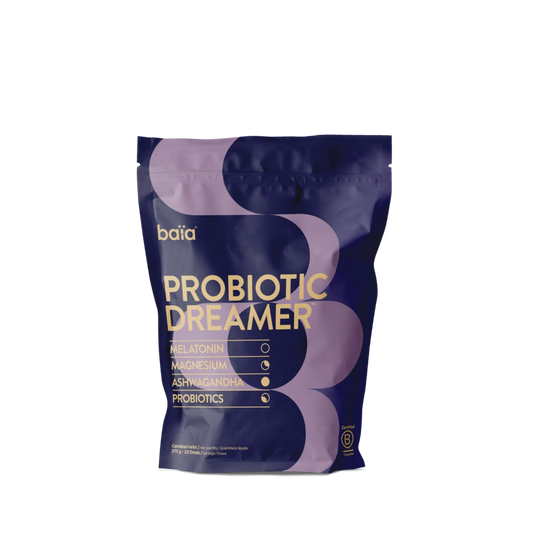
In this article I explain why anxiety and melatonin are so closely connected, how the gut influences this process, and which ingredients such as those in the Probiotic Dreamer™ can help you regulate the gut-brain axis naturally and effectively.
What does melatonin have to do with anxiety?
Melatonin is a hormone that the body naturally produces in the pineal gland, from serotonin, and serotonin in turn comes from tryptophan. Although it is known as “the sleep hormone,” in reality it has many more functions:
-
It regulates circadian rhythms and helps you enter deep sleep
-
It modulates the tone of the autonomic nervous system (reducing sympathetic activation), that is, it relaxes us.
-
It has a powerful antioxidant and anti-inflammatory effect in the brain.
-
It interacts with neurotransmitters such as GABA, serotonin, and dopamine, which are key for emotional stability.
When melatonin fails, you do not just sleep poorly: vulnerability to anxiety, insomnia, mental exhaustion, and emotional hypersensitivity also increases.
The role of the gut in all of this
Your gut is not just a digestive organ. It is also a center for the production of neurochemical signals. More than 80% of the body’s serotonin is produced here, and it can later be converted into melatonin.
But that only happens if:
-
Your microbiota is balanced
-
There is good intestinal function, without chronic inflammation
-
You have the necessary nutrients (tryptophan, magnesium, vitamin B6, etc.)
Intestinal dysbiosis (an imbalance of the microorganisms in the gut) or a damaged barrier can reduce the natural production of serotonin and melatonin, increase systemic inflammation, and keep your nervous system constantly in “alert” mode.
The most effective approach: modulating the gut-brain axis
If what we are looking for is to reduce anxiety at the root, it is not enough to “relax the mind.” It is necessary to intervene in the biological terrain that is fueling that response: the microbiota, systemic inflammation, nerve signaling, and the quality of deep sleep.
For this, certain nutrients and compounds have scientific evidence in this regard. That said, not all are suitable in every case.
Here I detail how they work —and in which cases caution is advisable—:
Lactobacillus gasseri CP2305®
-
It does not need to colonize: it acts as a biological signal that modulates the autonomic nervous system, reduces the stress response, and improves sleep quality.
-
It has even been studied in people with work-related stress, showing improvements in emotional tolerance and rest patterns.
Plant melatonin (Melostacio™) extracted from pistachio
-
It provides natural phytomelatonin (non-synthetic), which may help synchronize the circadian rhythm in a more physiological way, especially in cases of sleep-onset insomnia.
-
Unlike pharmaceutical melatonin, its profile is gentler and more respectful of hormonal dynamics.
Precaution:
Long-term use is not recommended without supervision during pregnancy, breastfeeding, in minors, or in people with neurological disorders.
Magnesium (citrate complex and ATA-Mg® – magnesium acetyl taurate)
-
It participates in more than 300 enzymatic processes, and is essential for GABA production, muscle relaxation, and neurological calm.
-
ATA-Mg® has good penetration into the central nervous system, ideal for people with excessive nighttime mental activation.
Precaution:
Avoid or adjust in people with kidney insufficiency, and separate its intake if iron, calcium, or zinc are being taken, as they may compete for absorption.
Ashwagandha (Withania somnifera – KSM-66®)
-
An adaptogen with clinical support for cortisol reduction, improved sleep, and modulation of the HPA axis (hypothalamic-pituitary-adrenal).
-
It can be very useful in cases of chronic stress, anticipatory anxiety, and adrenal fatigue.
Precaution:
In people with hyperthyroidism, it may increase metabolic activation and is not always well tolerated.
Prebiotic fiber: inulin + FOS (Orafti®)
-
It acts as a substrate for beneficial bacteria that produce short-chain fatty acids such as butyrate, with an anti-inflammatory and calming effect on the central nervous system.
-
It supports the natural production of intestinal serotonin and improves microbial diversity.
Precaution:
In people with SIBO (bacterial overgrowth) or fructose intolerance, FOS may worsen abdominal distension and cause excessive fermentation.
It should be avoided or used only in later stages of intestinal treatment, when dysbiosis is controlled.
Conclusion: it is not just about sleeping, but about regulating from the root
When there is anxiety, insomnia, or a feeling of mental lack of control, the problem is not always “in the head”.
Many times it is a consequence of what is happening further down: in the gut, in the immune system, in silent inflammation, or in a microbiota that has lost diversity and rhythm.
Melatonin, beyond helping you sleep, is a key piece in that communication network between body and brain. But you cannot produce it properly if you do not care for the system that makes it.
That is why, before looking for quick fixes, it is worth looking inward:
-
How is your digestion?
-
Is your sleep deep, or just a buildup of hours?
-
Does your anxiety appear on its own, or together with bloating, fatigue, brain fog, or hormonal symptoms?
Only by understanding that context can you use the appropriate tools. Some formulas that combine ingredients such as plant-based melatonin, inactivated probiotics, magnesium, adaptogens, and prebiotic fiber may help you, provided they are well chosen, well formulated, and used appropriately according to your case.
All these ingredients are present in Probiotic Dreamer™, a product developed to modulate the gut-brain axis and support rest and emotional stability from a comprehensive approach.
If you feel that your anxiety and your rest are not in balance, it may be that the gut has more to do with it than you thought.